The Influencer Project (2026) Official Trailer 2: Release Date, Plot, Cast, and Found-Footage Breakdown
There is something particularly nasty about The Influencer Project. Not because it needs some elaborate supernatural mythology or a monster hiding in the dark, but because almost everything frightening about it already exists. The film takes the familiar machinery of influencer culture—followers, livestreams, location tags, sponsorships, constant filming—and turns it into the exact thing that puts its protagonist in danger. Directed by Danish filmmaker Mike Nybroe and produced in part by Eduardo Sanchez and Gregg Hale, the filmmakers behind The Blair Witch Project, the movie is clearly interested in the uncomfortable space between being watched and being hunted.
The United States theatrical release is set for October 2, 2026, with Hades Films, Point Neuf, and Voltron Global Media behind the distribution. Trailer 2 has pushed the film further into the horror conversation, especially among viewers who remember how effective found footage can be when it feels less like a conventional movie and more like something you probably were not supposed to find. The Influencer Project moves that idea away from the woods and into Copenhagen, where social media visibility becomes part of the threat.
Untamed Season 2 Netflix Release Date, Episode Count, and Schedule Analysis
The Plot: When Your Entire Online Life Becomes a Map
Chiara King plays a fictionalized version of herself, which gives the film an awkward layer of realism from the start. In reality, King is a British content creator and musician with more than 4.2 million TikTok followers and over 1.4 million on Instagram. Her online work covers beauty, dating, lifestyle, comedy, and the kind of personal content that makes an audience feel as though they know the person behind the account.
The movie takes that public persona and puts it under a much darker spotlight. A professional documentary crew approaches Chiara with a proposal to make an unfiltered behind-the-scenes film about her life as an influencer. The idea is to get away from the polished version of her online identity and show what actually happens when the cameras are supposedly off. For the production, Copenhagen becomes the backdrop, giving the crew access to Chiara around the clock.
At first, everything looks fairly familiar. There are brand deals, fan meetings, expensive hotel rooms, constant content production, and the endless pressure to keep the audience interested. The documentary seems to be doing exactly what it promised. Then the presence of another person begins to emerge around the edges of the footage.
Chiara’s followers can track her through livestreams and real-time location information. That detail becomes increasingly sinister as someone starts using the same information to follow her physically through Copenhagen. The digital trail that helped build her career has effectively become a set of directions for a stalker.
That is where the premise gets uncomfortable. Chiara has spent years making her life visible, but visibility is not the same thing as control. Once someone decides that access to her online life gives them some kind of personal claim over her, the distinction between follower and predator disappears frighteningly fast.
Trailer 2 Breakdown: The Mood Changes Fast
The second official trailer initially plays almost like a glossy influencer reel. Bright ring lights, screaming fans, flashing cameras, social-media energy everywhere. Chiara talks confidently about her relationship with her audience, and for a few moments the whole thing feels polished and deliberately artificial.
Then the soundtrack drops away. The bright pop atmosphere is replaced by a low, unsettling hum, and the trailer introduces the person hiding behind the username KingSlayer. The most disturbing moment comes when KingSlayer sends Chiara a direct message containing a live photograph of her. It is not an old picture pulled from her social media. The image proves that the person watching her is physically nearby.
From there, the trailer becomes much rougher. Security footage, phone recordings, livestream feeds, and frantic documentary-camera shots start colliding with each other. The clean visual language from the opening minutes is gone, replaced by footage that looks increasingly unstable and immediate.
The stalker’s appearance is one of the trailer’s strongest visual choices. At one point, the figure is shown wearing a medieval chain-link mask while standing silently in the shadows around Chiara’s accommodation. There is no need for the character to explain anything. The stillness does most of the work.
And then there are the comments. As the livestream continues, viewers argue over what they are seeing. Some believe the apparent danger is simply an elaborate publicity stunt. Others start wondering whether they are watching an actual murder unfold in real time. That detail matters because the audience inside the film becomes almost as disturbing as the person causing the violence.
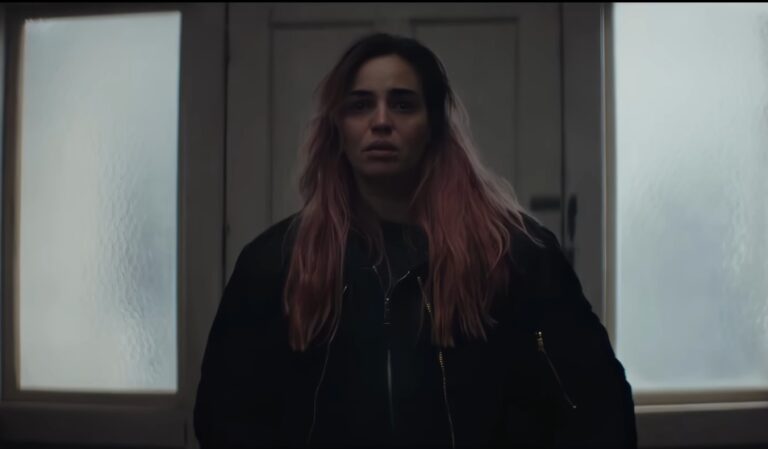
The trailer eventually turns into a series of claustrophobic chase sequences through dark corridors. The footage becomes breathless and disordered, leading to Chiara looking directly into the camera and making a desperate, tearful plea. It is a very familiar horror image, but here the camera itself has a nasty implication: even when she is begging for help, she is still being recorded.
Chiara King and the Cast
Chiara King is the center of the film, and The Influencer Project marks her feature-film debut. Playing a fictionalized version of herself obviously creates a strange performance challenge because the character is built from elements of King’s real public identity. Promotional comments from King have also connected the story to genuine concerns around privacy, personal boundaries, and the safety problems that can come with being constantly visible online.
The supporting cast includes Luca Storm, Jazmine Summer, Eos Karlsson, Gemma Karlsen, and Alexandre Willaume. Willaume brings some veteran screen experience to a movie otherwise built around a very contemporary setup, which could help give the more frantic sections a stronger dramatic anchor.
Behind the camera, Mike Nybroe directs and co-writes the screenplay with Anders Jon and Lars Andreas Pedersen. Nybroe uses Copenhagen in a way that should make the setting more than simple scenery. The city’s clean architecture and controlled visual spaces are set against a stalking campaign that becomes progressively messier and more invasive.
The Blair Witch Connection
The involvement of Eduardo Sanchez and Gregg Hale is probably the easiest piece of the film’s history to spot in the marketing. Both were part of the creative team behind The Blair Witch Project, one of the films most closely associated with the rise of mainstream found-footage horror in the late 1990s.
This time, the concept has moved from mysterious woods and improvised-looking video recordings to smartphones, livestreams, security cameras, and social platforms. The technology has changed dramatically, but the basic horror idea remains surprisingly similar: the footage is supposed to feel like evidence rather than entertainment.
Producers Alex Hertzberg, Ahmet Zappa, and Michael Sandager are also involved in the production. The filmmaking approach reportedly focuses on making the cameras and interfaces feel native to the world of the story rather than adding a polished Hollywood layer over everything.
Why the Found-Footage Style Fits This Story
The format makes sense because Chiara’s entire existence in the movie is already built around recording herself. Her phone is a camera. Her livestream is a camera. The documentary crew brings more cameras. Security systems add more cameras. Even the audience watching from home becomes part of the chain.
That creates an interesting problem for the character. There is nowhere to hide because the same technology that might document what happens to her is also what makes her easy to find. Location tags, high-definition footage, livestreams, and constant updates are supposed to make her more connected to followers. Instead, they allow a stranger to build a detailed picture of where she is and what she is doing.
The production’s use of smartphone formats, simulated livestream interfaces, and distorted audio should help sell that illusion. If the film gets the technical details right, some sequences may feel less like conventional horror scenes and more like footage pulled from a chaotic online feed.
Parasocial Relationships Become the Real Horror
The strongest idea in The Influencer Project is not really the stalker. It is the relationship between the stalker and the audience that makes the story uncomfortable. Social platforms encourage creators to share intimate pieces of their lives, and viewers can watch those moments every day. Breakfast, relationships, arguments, anxiety, jokes, personal questions—things that once belonged to private life can now become regular content.
That constant access can create the illusion of friendship. A follower may feel that they understand a creator because they have watched hundreds of videos, even though the creator has never met them. For most people, that remains harmless. The film is interested in what happens when someone takes that imagined connection much too far and begins treating access as ownership.
Chiara’s situation becomes particularly cruel because the tools that helped create her career also help destroy her privacy. Her smartphone, her camera, her location information, and her need to remain visible are all turned against her. The audience does not just watch the danger; in a sense, the audience helps create the environment in which the danger can happen.
There is another uncomfortable layer in the livestream comments. People watching the events are not necessarily trying to help. Some are arguing about whether the whole thing is fake. Others are treating the unfolding horror as entertainment. That reflects a familiar internet habit: once something becomes content, empathy can disappear surprisingly quickly.
The Influencer Project Release Date and Details
The film is scheduled to open exclusively in United States theaters on October 2, 2026. Producer Ahmet Zappa has emphasized the communal side of theatrical horror, and this particular concept seems designed for a room full of people reacting to the same disturbing footage at once.
The international rollout continues later in the autumn. The current theatrical schedule includes the following dates:
- United States: October 2, 2026
- United Kingdom: October 16, 2026
- Denmark: October 29, 2026
- Additional international markets: Continuing into November 2026
The Motion Picture Association has given the movie an R rating for strong bloody violence, themes of suicide, and pervasive language. The runtime is listed at 1 hour and 35 minutes, or 95 minutes, which fits the premise. A stalking story like this probably benefits from staying lean rather than stretching its central threat across two hours.
The Influencer Project Cast and Production Facts
| Detail | Information |
|---|---|
| Director | Mike Nybroe |
| Screenplay | Mike Nybroe, Anders Jon, Lars Andreas Pedersen |
| Lead | Chiara King |
| Supporting Cast | Luca Storm, Jazmine Summer, Eos Karlsson, Gemma Karlsen, Alexandre Willaume |
| Producers | Eduardo Sanchez, Gregg Hale, Alex Hertzberg, Ahmet Zappa, Michael Sandager |
| US Release | October 2, 2026 |
| UK Release | October 16, 2026 |
| Denmark Release | October 29, 2026 |
| Runtime | 95 minutes |
| Rating | R |
Is The Influencer Project Based on a True Story?
Not literally. The Chiara King seen in the film and the specific events taking place in Copenhagen are part of a scripted fictional story. The movie is, however, heavily influenced by real incidents involving stalking, online harassment, privacy violations, and security concerns experienced by social media personalities.
That distinction is important because the movie is borrowing credibility from real digital culture rather than presenting itself as a direct reconstruction of one particular case. Casting a real influencer as a fictionalized version of herself makes that line deliberately harder to see, which is part of the film’s appeal as a found-footage horror concept.
Who Directed and Produced The Influencer Project?
Danish filmmaker Mike Nybroe directs the movie and shares the screenplay credit with Anders Jon and Lars Andreas Pedersen. Eduardo Sanchez and Gregg Hale serve as producers, bringing their connection to The Blair Witch Project and decades of experience with found-footage horror into the production.
That connection does not mean this is simply Blair Witch with smartphones. The technology and social context are completely different. But the central idea of presenting frightening material as something captured rather than staged is clearly part of the film’s DNA.
When Does The Influencer Project Come Out?
The Influencer Project is scheduled to open in United States theaters on October 2, 2026. The UK theatrical release is planned for October 16, followed by Denmark on October 29 and a wider international rollout extending into November.
What Is the Rating and Runtime?
The film has an R rating for strong bloody violence, language, and intense thematic material including suicide. Its confirmed runtime is 95 minutes, keeping the story within a relatively tight feature length.
What makes the movie interesting before release is the way its horror mechanism is painfully ordinary. There is no need to imagine some distant future where technology becomes dangerous. The tools are already in everyone’s pockets. The Influencer Project simply asks what happens when the wrong person learns how to use them.